
Does My Sourdough Starter Need to Pass the Float Test?
No — your starter doesn't have to pass the float test. The test is unreliable: a spoonful of active starter often floats, but a starter that's perfectly ready to bake can still sink, especially if it's wetter or rye-heavy. Don't throw out a good starter over a failed float. Read its rise, dome, bubbles and aroma instead — those four signs together are far more reliable.
The float test is the most repeated piece of sourdough advice on the internet — and one of the most misleading when it's treated as a pass/fail exam. Here's what it actually measures, why it fails good starters, and what to trust instead.
What the float test is
Drop a small spoonful of starter into a glass of water. The idea: an active starter is full of carbon-dioxide bubbles, so it's buoyant and floats; a flat, inactive one sinks. As a quick gut-check, that logic isn't wrong — a floating blob does tell you there's gas in there.
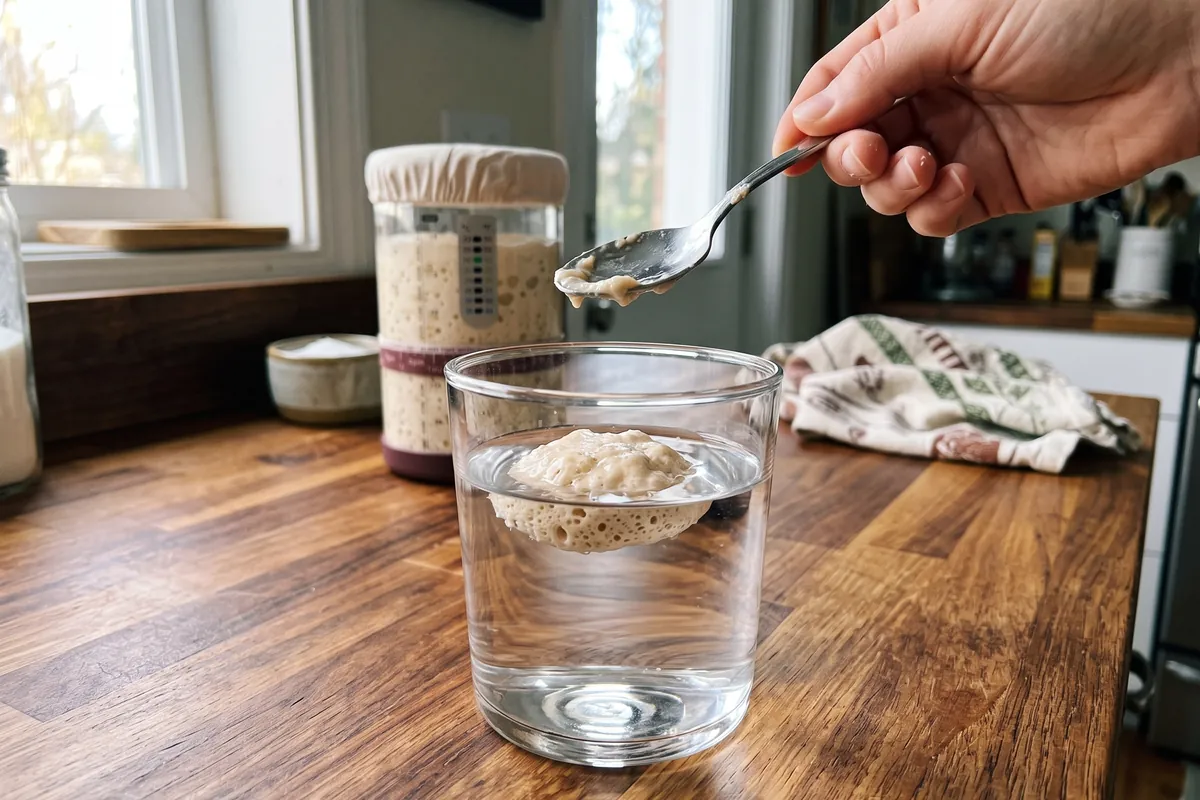
Why it fails perfectly good starters
The problem is the false negatives — ready starters that sink:
- You're past the peak. A starter floats best right at its peak. An hour or two later it has started deflating and releasing gas, so it sinks — even though it's still great to bake with.
- It's a wetter (higher-hydration) starter. More water means a looser structure that traps gas less efficiently, so it sinks while fully active.
- It's rye or whole-grain heavy. These starters are denser and notoriously sink even at their most vigorous.
- You scooped from the bottom. The gassy, active part is usually up top; a spoonful from the bottom sinks regardless.
The float test only tells you there's gas in the starter — nothing more. A starter that sinks can still be perfectly ready to bake.
Want a second opinion that isn't a coin toss? BakeSide reads your starter from a single photo and tells you whether it's genuinely at peak and ready — accounting for the hydration and flour type the float test ignores. Get BakeSide free →
What to read instead
Judge readiness by four signs, together — not one test:
| Sign | What "ready" looks like |
|---|---|
| Rise | Roughly doubled (some triple) since feeding |
| Dome | Surface domed at peak, just starting to flatten |
| Bubbles | Bubbles throughout the culture, seen through the jar |
| Aroma | Pleasantly tangy and yeasty, not sharp or foul |
The most reliable single habit is timing: mark the jar at feeding height and use your starter when it's near its peak — about 4–8 hours after feeding at ~24°C. If it doubles predictably and smells right, it's ready, float or no float.
BakeSide's take. BakeSide reads readiness from a photo the way an experienced baker does — it reads the rise, bubble structure and activity stage, together with the temperature and last feed you tell it — rather than a single float test. That's a fuller picture than a spoonful of starter in water can give.
So should you ever use it?
As a five-second sanity check, sure — if it floats, you've got confirmation there's gas. Just never let a sink talk you out of baking, and never discard a starter because it failed. The float test is a hint, not a verdict.
Frequently asked questions
Does my sourdough starter have to pass the float test?
No. The float test is unreliable — a starter that's perfectly ready to bake can still sink, especially wetter or rye-heavy ones. Judge by rise, dome, bubbles, and aroma instead.
Why does my active starter sink in the float test?
Common reasons: you're past the peak and it has released gas, it's a higher-hydration starter, it's rye or whole-grain heavy, or you scooped from the gasless bottom of the jar. None mean it's inactive.
What is a more reliable test than the float test?
Timing plus the four visual signs. Mark the jar at feeding height and use the starter near its peak (about 4–8 hours after feeding at ~24°C), when it has roughly doubled, domed, is bubbly throughout, and smells pleasantly tangy.
Is the float test ever useful?
As a five-second sanity check, yes — a float confirms there's gas in the starter. Just never treat a sink as a fail or discard a good starter because of it.
Can I bake if my starter fails the float test?
Yes, as long as the four signs say it's ready. A sink is a false negative far more often than a real warning, so don't let it stop you.
About the makers
BakeSide is made by the team behind Superbaking, a community of 500,000+ home bakers. Its starter guidance comes from real baking and from the thousands of starter photos BakeSide users send for feedback. Every guide here is written from that hands-on experience and human-edited.
Not sure what you're looking at?
BakeSide reads your starter from a single photo — tell it your temperature, smell and last feed, and it tells you exactly what to do next.