
How to Revive a Sourdough Starter (Day-by-Day)
Think you killed your sourdough starter? You almost certainly didn't. A neglected starter is dormant, not dead, and revives in 3–5 days: pour off any liquid, discard down to a spoonful, feed 1:2:2 with fresh flour and filtered water every 12 hours, and keep it warm (21–26°C). Only start over if you see fuzzy mold or smell something genuinely rotten.
Starters are far tougher than they look. They can sit forgotten in the back of the fridge for weeks — sometimes months — go grey, smell like paint thinner, and still bounce back with a few days of steady feeding. Here's how to bring one back, and how to tell the rare genuine loss from ordinary dormancy.
Dormant or dead? Check this first
This is the only decision that matters before you start:
- Dormant (revive it): flat or barely rising, a layer of dark liquid (hooch) on top, a sharp, boozy, or acetone-like smell. All completely normal for a hungry, neglected starter.
- Compromised (discard & restart): fuzzy or raised spots of any colour, or pink/orange streaks — or a genuinely rotten, putrid smell (not just sharp). Any one is enough; don't try to scrape mold off. (A flat, dry white film is just kahm yeast — skim it and carry on.)
A grey liquid and a smell like nail-polish remover are hunger, not death. Fuzzy or raised spots of any colour — or pink/orange streaks — are the real red flag.
Not sure if yours is dormant or done? Snap a photo in BakeSide and it tells you whether your starter is worth reviving, spots mold you might miss, and walks you through the feeds day by day. Get BakeSide free →
The revival routine, day by day
You'll need fresh flour (a little rye or whole wheat helps a lot), filtered water, and a warm spot around 21–26°C (70–79°F).
Day 1 — reset and feed
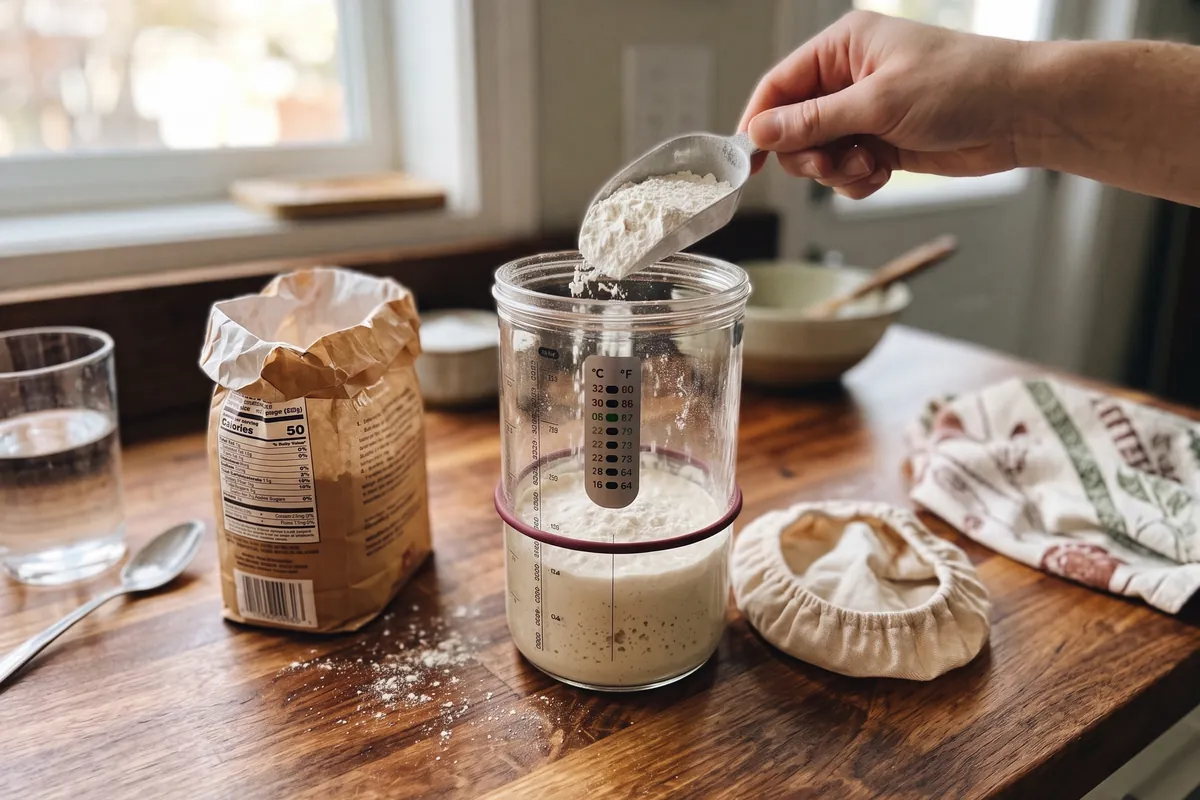
Pour off any hooch. Discard all but about 1–2 tablespoons of starter — this concentrates the healthiest culture and removes the acidic buildup holding it back. Feed at 1:2:2 (for example 10 g starter : 20 g flour : 20 g water). Cover loosely and keep warm. Expect little to nothing today.
Day 2 — first signs
Feed again at 1:2:2 (discard down first if it grew). Look closely: you're hoping for small bubbles and a faint change in smell from sharp toward yeasty. Even a few bubbles mean it's waking up. Still flat? Keep going — day 2 is often quiet.
Days 3–5 — the rise returns
Continue feeding every 12 hours. Somewhere in here you should see a real rise — the starter climbing and doming between feeds, then falling as it gets hungry. Once it's roughly doubling within about 4–8 hours and smells pleasantly tangy, it's back and ready to bake.
| Day | What to do | What to expect |
|---|---|---|
| 1 | Pour off hooch, discard to 1–2 tbsp, feed 1:2:2 | Little or no activity |
| 2 | Feed 1:2:2 every 12 h | Small bubbles, smell softening |
| 3–4 | Keep feeding every 12 h, warm | Partial rise, more bubbles |
| 5 | Feed; test readiness | Doubles in 4–8 h, tangy smell — ready |
BakeSide's take. The vast majority of "I think it's dead" starters are simply dormant — and the recovery path is consistent: warmth, a clean 1:2:2 feed, and patience.
If it still won't wake up
Give it a full 5–7 days before giving up — cold kitchens make everything slower. Two boosts that reliably help: switch to (or add) rye or whole-wheat flour for a feed or two, and find a warmer spot. If after a week of warm, consistent feeding there's genuinely no bubbling and no rise, then it's time to start a fresh starter — but that's the exception, not the rule.
Frequently asked questions
Can a sourdough starter really come back from the dead?
Almost always — because it's usually not dead, just dormant. Starters survive weeks or months of neglect in the fridge and revive with 3–5 days of warm, steady 1:2:2 feeding.
How do I tell a dormant starter from a truly dead one?
Dormant looks sluggish with hooch and a sharp, boozy smell — all normal. Truly compromised means fuzzy or raised mold of any colour, pink/orange streaks, or a genuinely rotten, putrid smell. Only that case is a discard-and-restart.
How long does it take to revive a sourdough starter?
Typically 3–5 days. Expect little on day 1, small bubbles by day 2, and a clear rise by days 3–5. Cold kitchens can stretch it to 5–7 days.
Do I need to discard before each revival feed?
Yes. Discarding down to 1–2 tablespoons concentrates the healthiest culture and removes the acidic buildup that holds a neglected starter back, so each feed has a stronger base to grow from.
Should I use rye or whole-wheat flour to revive it?
It helps a lot. Rye and whole wheat carry more wild microbes, so adding a portion for a feed or two is one of the most reliable ways to wake a stubborn starter.
About the makers
BakeSide is made by the team behind Superbaking, a community of 500,000+ home bakers. Its starter guidance comes from real baking and from the thousands of starter photos BakeSide users send for feedback. Every guide here is written from that hands-on experience and human-edited.
Not sure what you're looking at?
BakeSide reads your starter from a single photo — tell it your temperature, smell and last feed, and it tells you exactly what to do next.